Why healthcare leaders must prioritise data quality
Every day, clinicians and executives make consequential decisions based on data generated by electronic health record (EHR) systems. But how often do those decisions rest on a foundation that is incomplete, inconsistent, or inaccurate? Across the global healthcare sector, enterprise data quality remains one of the most underappreciated and most costly strategic blind spots. For healthcare leaders, it is no longer an IT concern to be delegated downward: it is a core governance responsibility with direct implications for patient safety, operational efficiency, and commercial performance.
Seven Dimensions, One Picture
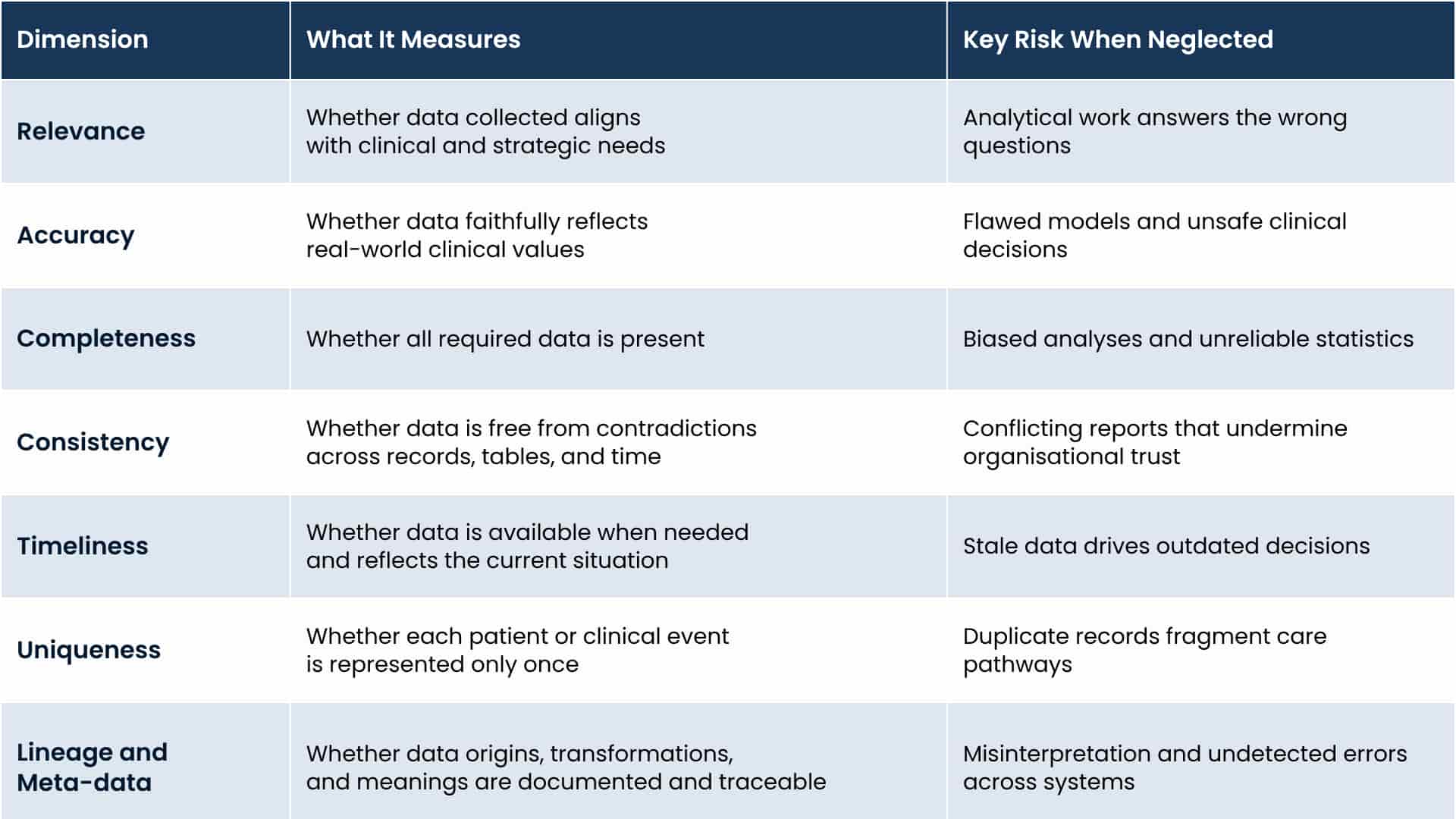
Data quality is not a single property but a multidimensional construct. Seven dimensions matter: relevance, accuracy, completeness, consistency, timeliness, uniqueness, and lineage and meta-data. A dataset can score well on completeness, with every field populated, while failing on accuracy because values entered are clinically implausible. Understanding all seven dimensions simultaneously is what separates a meaningful assessment from a superficial audit.
The Scale of the Problem
The evidence is sobering. Research has consistently shown that completeness rates for key clinical variables in EHRs routinely fall below 70%, and that missingness is frequently systematic, meaning the gaps are not random noise but structural failures built into how data is collected and managed. Duplicate patient records are equally pervasive, affecting between 8% and 20% of records in large health systems, directly causing care fragmentation and avoidable repeat investigations.
The financial consequences are substantial. Poor data quality costs the US economy an estimated $3.1 trillion annually. Within healthcare specifically, more than $265 billion per year in unnecessary administrative costs have been attributed to data interoperability and quality failures. These figures translate into misallocated resources, missed diagnoses, and poor decisions made on unreliable ground. Sadly, robust, peer-reviewed cost estimates specifically attributing financial losses to poor data quality in the South African healthcare sector do not exist in the same way they do for the US context. However, the South African private medical scheme sector alone loses an estimated R30 to 45 billion annually to fraud, waste, and abuse, a meaningful portion of which is enabled by poor data quality, duplicate records, and inadequate coding. Meanwhile, the public sector's reliance on manual and semi-digital health information systems has produced systematic reporting gaps that compromise both clinical oversight and strategic planning."
Why the Problem Persists
EHR systems typically evolve organically, accreting features and fields in response to regulatory and operational pressures, rather than being designed around analytical utility. The result is heterogeneous data entry practices, inconsistent clinical coding, poorly documented data transformations, and siloed data that cannot be joined across systems. Front-line clinicians, the primary data generators, are rarely trained in data stewardship; their understandable focus on the patient in front of them means that completeness and precision are frequently deprioritised. Many organisations discover these structural problems only when they attempt to use data for analytics or strategic reporting, at which point the cost of remediation is at its highest.
Formal Assessment: From Symptom to Root Cause
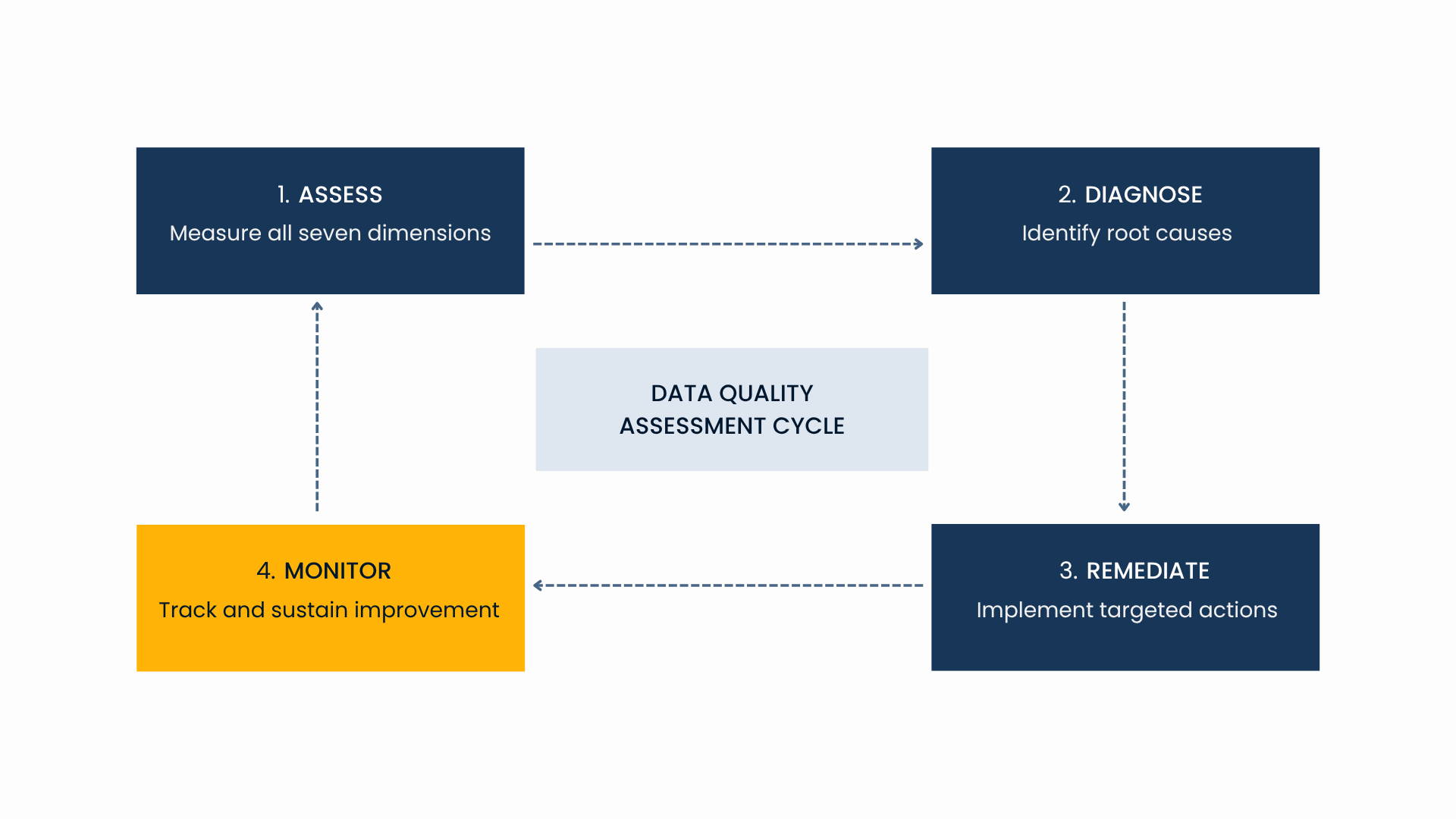
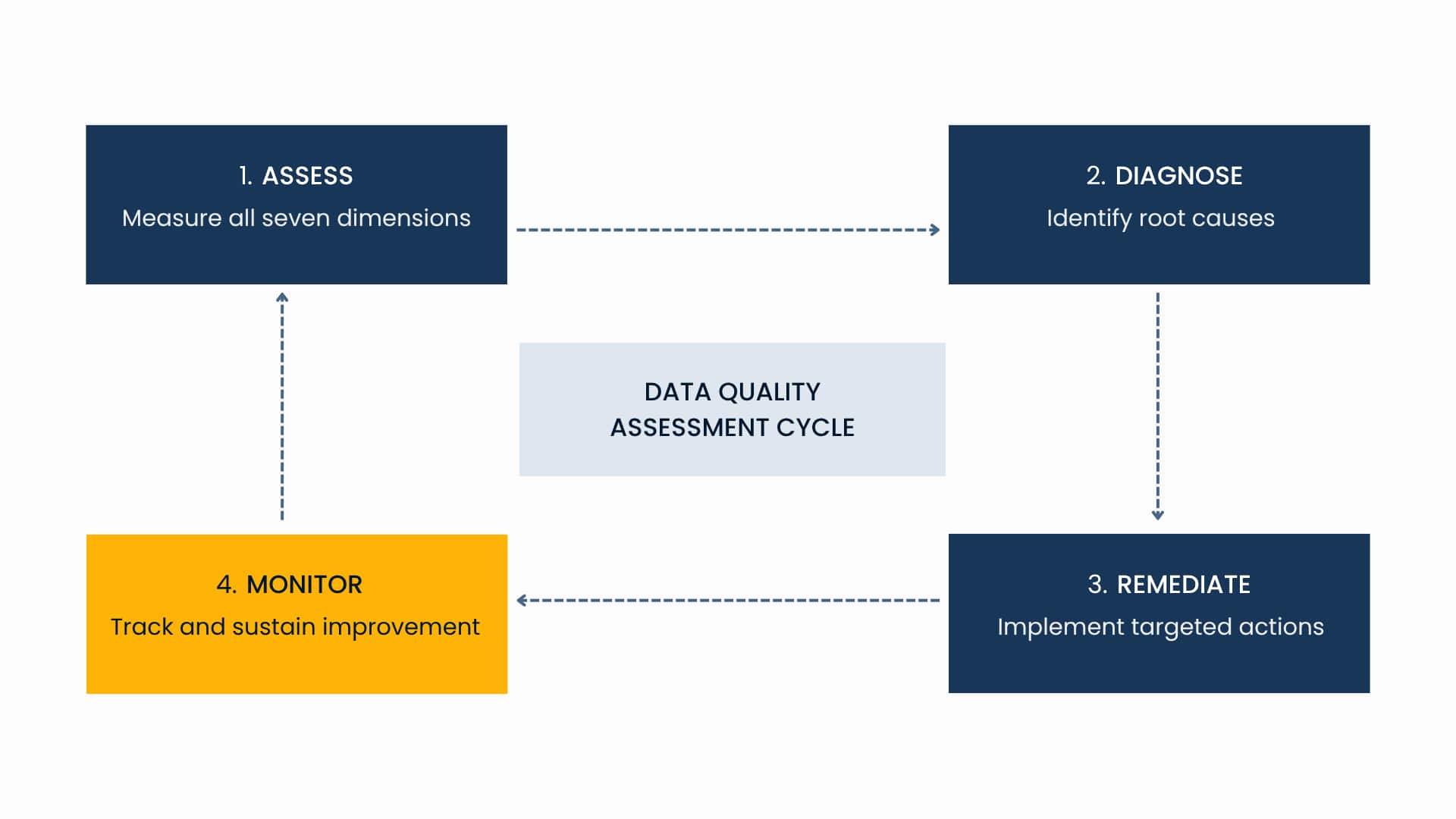
A structured data quality assessment, evaluating all seven dimensions at field, record, service-category, location, and time-period levels, transforms a vague awareness of data problems into a precise, actionable diagnosis. The methodology combines quantitative metrics, such as field-level missingness rates, duplicate detection algorithms, temporal consistency checks, and coding accuracy audits, with qualitative stakeholder engagement to understand how and why data is entered the way it is, and where the workflow bottlenecks lie. Figure 1 illustrates the iterative nature of this process.
The output of a formal assessment is not merely a score. It is a roadmap: a clear view of which data subsets are fit for clinical and strategic analytics, and where targeted investment in system configuration, training, governance, or tooling will yield the greatest return. Crucially, it also identifies which analytical models and decision-support tools can be deployed immediately, and which require data remediation first.
The Return on Investment Is Real
The business case for data quality investment is well-evidenced. Geisinger Health System's decade-long programme of EHR data governance contributed to a 20% reduction in hospital readmissions and measurable improvements in chronic disease management. Kaiser Permanente's integrated, data-quality-driven care management approach has been associated with approximately $1,200 in savings per high-risk patient per year through the prevention of avoidable hospitalisations. The NHS, following national data quality improvement initiatives, reported that standardised data enabled more accurate population health stratification, directly informing resource allocation decisions worth hundreds of millions of pounds annually.
Organisations that have invested in resolving duplicate patient records report not only improved care coordination but direct cost savings from eliminated redundant investigations. In each case, the critical enabler was not new data: it was understanding and improving the quality of data already being collected as part of routine clinical operations.
A Strategic Imperative
Senior leaders who treat data quality as a non-issue are leaving strategic value on the table and exposing their organisations to avoidable clinical and commercial risk. The organisations achieving the greatest return from their data investments share one characteristic: they invest in understanding the quality of the data they hold before deploying it in analytics and decision-support tools. A formal, structured data quality assessment is not the end of the journey. It is where the journey must begin.
If this resonates with you; whether you are grappling with a specific data challenge, considering a formal assessment, or simply want to think through what good data governance could look like in your organisation, I would welcome the conversation. Feel free to reach out via a LinkedIn message or hello@wimmy.com.